Desarrollaron un novedoso método para “espiar” microestructuras en tejidos biológicos

DESARROLLARON UN NOVEDOSO MÉTODO PARA “ESPIAR” MICROESTRUCTURAS EN TEJIDOS BIOLÓGICOS
Un equipo de científicos en el que participa un docente del Instituto Balseiro desarrolló un novedoso método que permite generar nuevas formas de imágenes a partir de resonancia magnética nuclear (RMN). Así, los investigadores lograron mapear información morfológica de sistemas químicos y biológicos a una escala menor a la tradicional. El trabajo fue publicado en una de las revistas del grupo Nature, “Scientific Reports”.
Source: Desarrollaron un novedoso método para “espiar” microestructuras en tejidos biológicos
Internal gradient distributions: A susceptibility-derived tensor delivering morphologies by magnetic resonance | Scientific Reports
Gonzalo A. Álvarez, Noam Shemesh & Lucio Frydman
Scientific Reports 7, 3311 (2017)
doi:10.1038/s41598-017-03277-9
Nuclear magnetic resonance is a powerful tool for probing the structures of chemical and biological systems. Combined with field gradients it leads to NMR imaging (MRI), a widespread tool in non-invasive examinations. Sensitivity usually limits MRI’s spatial resolution to tens of micrometers, but other sources of information like those delivered by constrained diffusion processes, enable one extract morphological information down to micron and sub-micron scales. We report here on a new method that also exploits diffusion – isotropic or anisotropic– to sense morphological parameters in the nm-mm range, based on distributions of susceptibility-induced magnetic field gradients. A theoretical framework is developed to define this source of information, leading to the proposition of internal gradient-distribution tensors. Gradient-based spin-echo sequences are designed to measure these new observables. These methods can be used to map orientations even when dealing with unconstrained diffusion, as is here demonstrated with studies of structured systems, including tissues.

Rev. Mod. Phys.:Protecting quantum information against environmental noise
Colloquium: Protecting quantum information against environmental noise
Dieter Suter and Gonzalo A. Álvarez
Rev. Mod. Phys. 88, 041001 (2016)
Published 10 October 2016
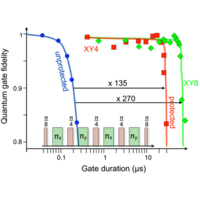 Quantum-mechanical systems retain their properties so long as the phase of quantum superpositions evolve stably over time. Contact with an environment can disrupt this phase evolution. But for environments that do not exchange energy with the quantum system, strategies exist where the controlled driving of the system can recover or maintain the quantum phase. This Colloquium surveys the host of techniques that are available to “refocus” the phase when disturbed by various forms of classical or quantum environment. While the first such techniques were developed long ago, ideas from quantum information theory have introduced new strategies for accomplishing this goal.
Phys. Rev. Applied: Maximizing Information on the Environment by Dynamically Controlled Qubit Probes
Maximizing Information on the Environment by Dynamically Controlled Qubit Probes
Analia Zwick, Gonzalo A. Álvarez, and Gershon Kurizki
Phys. Rev. Applied 5, 014007 (2016)
Published 25 January 2016
 From computers to medicine, miniaturization approaches the atomic scale, where device operation can be dominated by quantum effects that are strongly coupled to the local environment. These influences may be seen not as a nuisance, but rather a nearly untapped source of information about physical or biochemical processes playing out nearby. How can one extract maximum information from such fluctuations with an atomic probe, under typical experimental constraints? The authors use quantum estimation theory to outline a general strategy for dynamical measurement of a broad class of environmental processes.
Source: Physical Review Applied – Volume 5 Issue 1

Nat. Commun.: Local and bulk 13C hyperpolarization in nitrogen-vacancy-centred diamonds at variable fields and orientations
Gonzalo A. Álvarez, Christian O. Bretschneider, Ran Fischer, Paz London, Hisao Kanda, Shinobu Onoda, Junichi Isoya, David Gershoni & Lucio Frydman
Nature Communications 6, 8456 (2015). doi:10.1038/ncomms9456
 Polarizing nuclear spins is of fundamental importance in biology, chemistry and physics. Methods for hyperpolarizing 13C nuclei from free electrons in bulk usually demand operation at cryogenic temperatures. Room temperature approaches targeting diamonds with nitrogen-vacancy centres could alleviate this need; however, hitherto proposed strategies lack generality as they demand stringent conditions on the strength and/or alignment of the magnetic field. We report here an approach for achieving efficient electron-13C spin-alignment transfers, compatible with a broad range of magnetic field strengths and field orientations with respect to the diamond crystal. This versatility results from combining coherent microwave- and incoherent laser-induced transitions between selected energy states of the coupled electron–nuclear spin manifold. 13C-detected nuclear magnetic resonance experiments demonstrate that this hyperpolarization can be transferred via first-shell or via distant 13Cs throughout the nuclear bulk ensemble. This method opens new perspectives for applications of diamond nitrogen-vacancy centres in nuclear magnetic resonance, and in quantum information processing.

Quanten-Computer löst Quanten-Problem :: pro-physik.de
Quanten-Computer löst Quanten-Problem
Einfluss von Störungen auf das Ausbreiten eines Quantensystems untersucht.
Source: :: Quanten-Computer löst Quanten-Problem :: pro-physik.de
Physiker lösen Problem mit Hilfe von Quanten-Computer der TU Dortmund
See the article about our work “Localization-delocalization transition in the dynamics of dipolar-coupled nuclear spins” in the idw – Informationsdienst Wissenschaft online magazine: Physiker lösen Problem mit Hilfe von Quanten-Computer der TU Dortmund
Physiker lösen Problem mit Hilfe von Quanten-Computer der TU Dortmund
See the article about our work “Localization-delocalization transition in the dynamics of dipolar-coupled nuclear spins” in the Innovation Report magazine: Physiker lösen Problem mit Hilfe von Quanten-Computer der TU Dortmund
Science: Localization-delocalization transition in the dynamics of dipolar-coupled nuclear spins
Nonequilibrium dynamics of many-body systems are important in many scientific fields. Here, we report the experimental observation of a phase transition of the quantum coherent dynamics of a three-dimensional many-spin system with dipolar interactions. Using nuclear magnetic resonance (NMR) on a solid-state system of spins at room-temperature, we quench the interaction Hamiltonian to drive the evolution of the system. Depending on the quench strength, we then observe either localized or extended dynamics of the system coherence. We extract the critical exponents for the localized cluster size of correlated spins and diffusion coefficient around the phase transition separating the localized from the delocalized dynamical regime. These results show that NMR techniques are well suited to studying the nonequilibrium dynamics of complex many-body systems.
Gonzalo A. Álvarez (1), Dieter Suter (2), Robin Kaiser (3)
(1) Department of Chemical Physics, Weizmann Institute of Science, 76100, Rehovot, Israel.
(2) Fakultät Physik, Technische Universität Dortmund, D-44221, Dortmund, Germany.
(3) Institut Non-Linéaire de Nice, CNRS, Université de Nice Sophia Antipolis, 06560, Valbonne, France.


via Localization-delocalization transition in the dynamics of dipolar-coupled nuclear spins.
PLoS ONE: Size Distribution Imaging by Non-Uniform Oscillating-Gradient Spin Echo (NOGSE) MRI
Noam Shemesh, Gonzalo A. Álvarez, Lucio Frydman
Published: July 21, 2015
DOI: 10.1371/journal.pone.0133201
Abstract
Objects making up complex porous systems in Nature usually span a range of sizes. These size distributions play fundamental roles in defining the physicochemical, biophysical and physiological properties of a wide variety of systems – ranging from advanced catalytic materials to Central Nervous System diseases. Accurate and noninvasive measurements of size distributions in opaque, three-dimensional objects, have thus remained long-standing and important challenges. Herein we describe how a recently introduced diffusion-based magnetic resonance methodology, Non-Uniform-Oscillating-Gradient-Spin-Echo(NOGSE), can determine such distributions noninvasively. The method relies on its ability to probe confining lengths with a (length)^6 parametric sensitivity, in a constant-time, constant-number-of-gradients fashion; combined, these attributes provide sufficient sensitivity for characterizing the underlying distributions in μm-scaled cellular systems. Theoretical derivations and simulations are presented to verify NOGSE’s ability to faithfully reconstruct size distributions through suitable modeling of their distribution parameters. Experiments in yeast cell suspensions – where the ground truth can be determined from ancillary microscopy – corroborate these trends experimentally. Finally, by appending to the NOGSE protocol an imaging acquisition, novel MRI maps of cellular size distributions were collected from a mouse brain. The ensuing micro-architectural contrasts successfully delineated distinctive hallmark anatomical sub-structures, in both white matter and gray matter tissues, in a non-invasive manner. Such findings highlight NOGSE’s potential for characterizing aberrations in cellular size distributions upon disease, or during normal processes such as development.
Citation: Shemesh N, Álvarez GA, Frydman L (2015) Size Distribution Imaging by Non-Uniform Oscillating-Gradient Spin Echo (NOGSE) MRI. PLoS ONE 10(7): e0133201. doi:10.1371/journal.pone.0133201
Editor: Ichio Aoki, National Institute of Radiological Sciences, JAPAN
Received: November 25, 2014; Accepted: June 24, 2015; Published: July 21, 2015
Copyright: © 2015 Shemesh et al. This is an open access article distributed under the terms of the Creative Commons Attribution License, which permits unrestricted use, distribution, and reproduction in any medium, provided the original author and source are credited
via PLOS ONE: Size Distribution Imaging by Non-Uniform Oscillating-Gradient Spin Echo (NOGSE) MRI.


